> For the complete documentation index, see [llms.txt](https://resmocom.gitbook.io/product/llms.txt). Markdown versions of documentation pages are available by appending `.md` to page URLs; this page is available as [Markdown](https://resmocom.gitbook.io/product/integrations/brex-integration.md).
# Brex Integration
Guide for Resmo Brex Integration
## Resmo + Brex Integration Fundamentals
Resmo Brex integration helps you gain visibility over your Brex resources, like companies, departments, and users, while keeping your environment secure and compliant.
### What does Resmo offer to Brex users?
* Collect your Brex assets like users, locations, departments, and companies in a single asset directory.
* Query your resources using SQL or free text search.
* Automate your security and compliance checks with managed or custom rules.
* Receive notifications when there is a rule change.
* Keep track of resource and configuration changes.
### How does the integration work?
Resmo uses API to do the initial polling and collect existing resources. Following the initial polling, it receives updates and changes in real-time through webhook and regular polling.
#### Available resources
{% embed url="" %}
## Integration walkthrough
### How to install
1. Select Brex on your Integrations page on Resmo.
2. Click the Add Integration button at the bottom right corner of the opening modal.
3. Log in to your Brex account on a new tab on your browser.
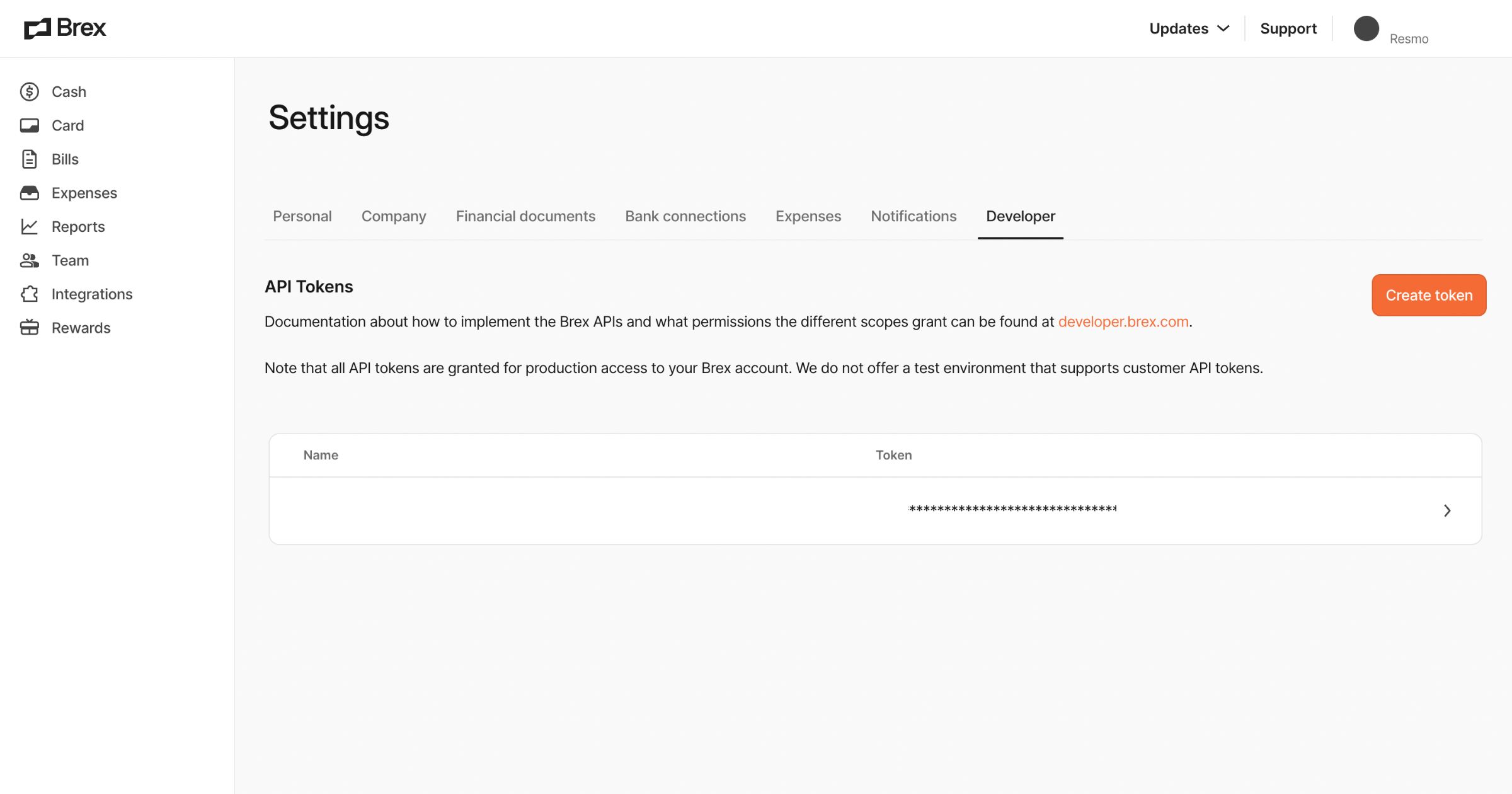
4. Go to **Create Token** under the **Developer -> Settings** page.
5. Create and copy the Read-only Auth Token from your Brex account. Required scopes:
{% hint style="info" %}
* Users Read
* Locations Read
* Departments Read
* Companies Read
{% endhint %}
6. Paste it to the API Token field on the setup page.
7. Hit the Create button.
8. That's it! Now you can start querying your Brex resources.
### How to uninstall
1. Select Brex on your Integrations page.
2. Navigate to the Connected Integrations tab on the opening modal and select the Brex integration you wish to remove.
3. To temporarily pause your Brex integration, click the Disable button. You can also permanently uninstall it by clicking the Delete button.